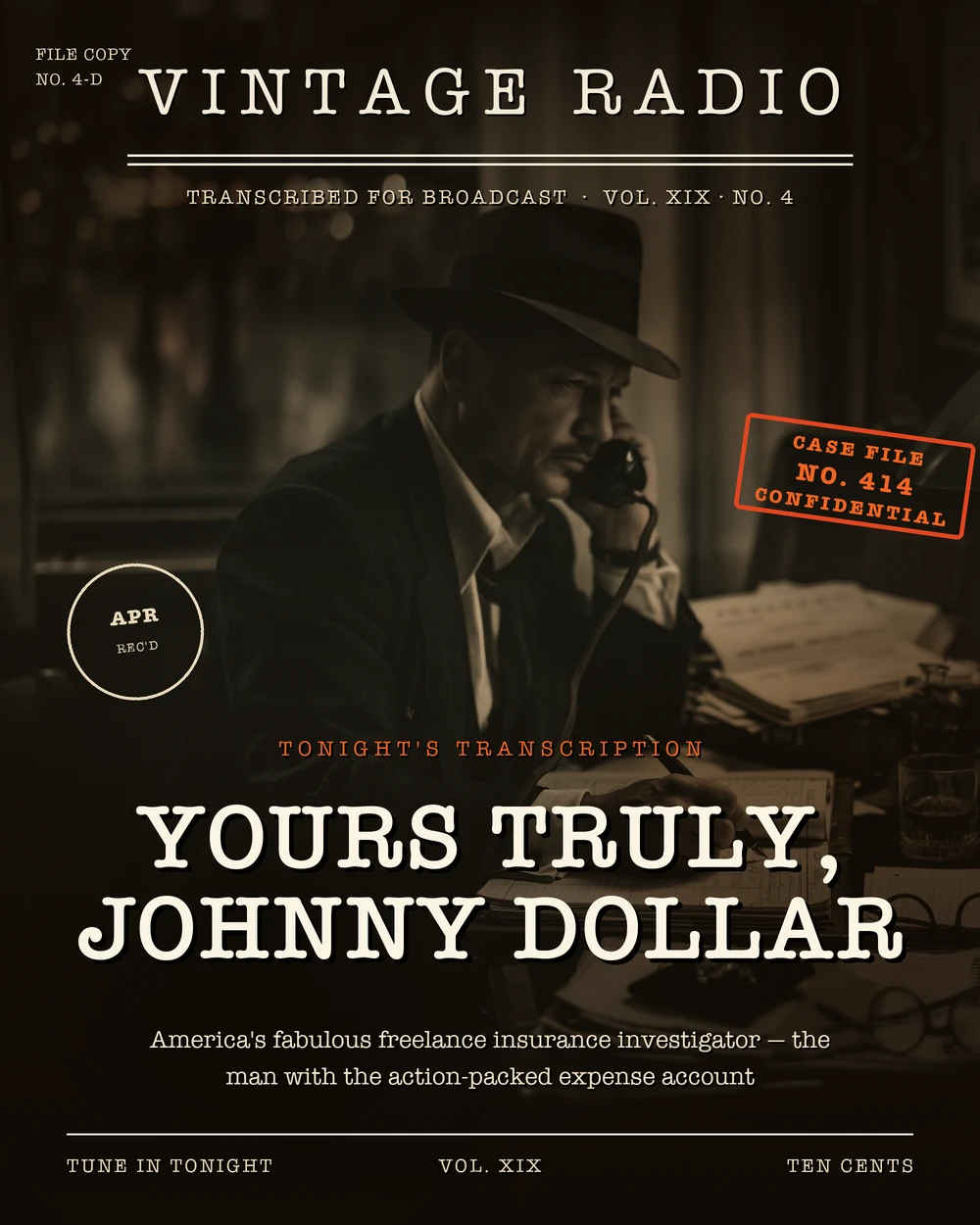
Yours Truly, Johnny Dollar
How It Got Started
The show that would close out the golden age of dramatic network radio nearly had a different name — and a different leading man. The original working title was "Yours Truly, Lloyd London," changed before the December 1948 audition to avoid legal problems with Lloyd's of London. According to researcher Terry Salomonson, the name "Lloyd London" was literally scratched out of the audition script and "Johnny Dollar" written in. Dick Powell was cast for that first audition, recorded December 8, 1948, with music by Richard Aurandt and scripts by Paul Dudley and Gil Doud under director Anton M. Leader. Powell passed on it — he was headed toward Richard Diamond, Private Detective — and the role went to Charles Russell for the actual premiere on CBS on February 11, 1949.
That premiere did not go over well. The show opened to derisive reviews in 1949, and the early episodes gave critics every reason to be skeptical. Russell played Dollar as a free-wheeling tipper who tossed silver dollars to busboys and doormen — a character flourish that soon disappeared. The description attached to Dollar across all the show's incarnations was "America's fabulous freelance insurance investigator" and "the man with the action-packed expense account." He worked primarily through a fictional clearing house called Universal Adjustment Bureau, with an executive named Pat McCracken as his main contact, taking cases that ran from stolen diamonds and art to arson investigations to bodyguard assignments for wealthy clients.
The series ended its first CBS run on January 14, 1950, after shifting around the schedule — Fridays, then Sundays, then Saturdays. Norman Macdonnell directed for a stretch starting that July before Gordon T. Hughes took over in November. Mark Warnow led the orchestra early on; Leith Stevens followed. None of it had quite clicked yet.
The Men Who Played Dollar
Over fourteen years on the air, including two unaired auditions, the title role changed hands seven times. The range in quality across those eras is stark.
Edmond O'Brien took over when the show returned February 3, 1950, bringing a gruff-sounding toughness to the character. O'Brien had natural credentials for the part — he had played an insurance investigator in the 1946 film noir The Killers — and he was a prestige hire by any measure, a Brooklyn-born film actor who would go on to win the Academy Award for Best Supporting Actor for The Barefoot Contessa in 1954 and earn a second nomination a decade later for Seven Days in May. The writing staff during his run included Paul Dudley, Gil Doud, E. Jack Neuman, David Ellis, and John Michael Hayes, with Jaime del Valle producing and directing. John Lund followed O'Brien when the third CBS run started November 28, 1952, with a portrayal described as much the same gruff type — and with little to distinguish either version of Dollar from the other radio detectives of the era. Blake Edwards joined the writing staff during the Lund years, alongside E. Jack Neuman, Les Crutchfield, and others, and Wrigley's Gum provided the longest continuous sponsorship the series ever enjoyed, from March 1953 through August 1954.
Then came Bob Bailey. His arrival in October 1955 — born Robert Bainter Bailey, June 13, 1913, in Toledo, Ohio — is where most serious listeners locate the show's real identity. Bailey came from a show-business family; his parents were stage actors, and he had been playing freelance detective George Valentine on Let George Do It for roughly nine years before taking on Dollar. He had appeared in seven feature films after being signed by 20th Century-Fox in 1943, including two Laurel and Hardy pictures. None of that background predicts what he became in the Dollar role, which he played in nearly 500 episodes between 1955 and 1960. Radio veteran Harry Bartell described Bailey as "a stylish, very professional actor whose voice fit perfectly into the two characters by which he is best known." Bailey himself put it this way: "If you know how to handle your voice in radio, it's almost impossible to destroy an illusion."
The most distinctive trait Bailey brought to Dollar was impatience — a character flaw built into the scripts that had Dollar charging into action after hearing only part of what someone was telling him. He also played the expense-account padding for comic relief, usually in pre-title exchanges with Pat McCracken. The show included a running cast of supporting Hollywood actors across this era: Virginia Gregg, John Dehner, William Conrad, Parley Baer, Howard McNear, Jack Kruschen, Barney Phillips, Vic Perrin, Lawrence Dobkin, and others appeared regularly. Gregg played Dollar's girlfriend Betty Lewis with enough frequency to be considered nearly a regular. Dollar was a confirmed bachelor who grumbled that his "crazy life" would be a detriment to marriage.
When CBS moved the show to New York in late 1960, Bailey was reportedly invited for a television pilot screen test but was turned away because producers said the character was "6 feet tall and 200 pounds," and Bailey stood 5 feet 9½ inches and weighed 150 pounds. Bob Readick took over the New York run in December 1960, followed by Mandel Kramer from June 1961 through the final broadcast. Both were members of CBS's New York stock acting company. Kramer, born in 1916, had been working in radio since at least a 1940 Columbia Workshop episode; after the show ended, he went on to a long career in television, including an Emmy nomination for Best Supporting Actor for his work on The Edge of Night in 1979.
The Serial Year
The most structurally unusual stretch of the show's run came when CBS switched the format to a 15-minute weeknight continuation serial starting October 3, 1955. Dollar aired Monday through Friday at 8:15 p.m. (later 9:15), with stories told in five parts that concluded within the same week. Each multi-chapter story got 75 minutes of air time — compared to 30 minutes in a standard half-hour episode — and that extra room made a difference in how much character development the scripts could carry.
Jack Johnstone, whose full name was Earl Ransom Johnstone, came aboard as producer-director for this era and stayed with the show through the move to New York. Johnstone had been in radio since 1932, starting on Buck Rogers in the 25th Century, and his credits included The Adventures of Superman, Crime Doctor, Richard Diamond Private Detective, The Six Shooter, and Hollywood Star Playhouse — where he introduced Marilyn Monroe to radio drama in an August 31, 1952 broadcast. His method on the 15-minute serial run was unusual: each episode was recorded straight through with no retakes. If an actor muffed a line, the entire session started over. Johnstone wrote approximately 350 scripts for the show under three pseudonyms — "Sam Dawson," "Jonathan Bundy," and combinations of those initials. When Bailey wrote one script himself, on December 22, 1957, he used the pen name "Robert Bainter" — his middle name — to work around network restrictions on paying the same person as both actor and writer. After Johnstone retired from radio at 56, he spent much of his time making audio recordings for the visually impaired; his family later asked that memorial donations be made to the Santa Barbara Chapter of Recordings for the Blind.
Raymond William Stedman criticized the five-chapter serials as "cliche-ridden." The assessment was disputed, with those who admired the serial run calling it some of the best work in the show's history. The format ran unsponsored for almost the entire season — only two of the 55 serial stories included a sponsor's message. The show returned to 30-minute half-hours in November 1956, and with that the serial experiment ended.
The Way It Sounded
Dollar narrated each case in the first person, building the story through expense account entries that began with "Expense account, item one" and ended with Dollar totaling the account and signing off "Yours truly, Johnny Dollar." The titles followed a consistent pattern: every episode was called "The [Something] Matter" — "The Silver Blue Matter," "The Forbes Matter," "The Carmen Kringle Matter" — which gave each case its own formal identity and made the structure immediately recognizable.
Cases typically started with a phone call from an insurance executive, usually sending Dollar to investigate a suspicious death, attempted fraud, or missing person. The smallest expense account item Dollar ever recorded was "two cents: what I felt like" after a professional setback. The largest was "one million dollars," reflecting how he felt after finding a missing woman and her child in a snowbound cabin. Recurring characters besides McCracken included Betty Lewis, a friend named Randy Singer at police headquarters, an arsonist-turned-informant named Smoky Sullivan, and an eccentric called Alvin Peabody Cartwright. Dollar's cases took him across 39 U.S. states and 24 foreign countries over the run of the series.
Later Bailey-era episodes added a sly meta-narrative twist: within the fiction, Dollar himself had a radio program recounting his adventures as true events, and other characters would occasionally recognize his voice from the air. The device became an actual plot point in "The Salkoff Sequel Matter." The show indulged the occasional celebrity guest in the same self-aware spirit — Vincent Price appeared as himself in "The Price of Fame Matter," traveling with Johnny to Europe on the case.
The show had a noticeably different sound after moving to New York — different acoustic character, a different supporting cast, different rhythms. Johnstone continued sending scripts from Hollywood through the New York production period, which kept some continuity in the writing, but the texture changed. The West Coast supporting ensemble — Gregg, Dehner, McNear, Baer, Conrad — gave way to a New York company that included Joan Lorring, Robert Dryden, Ralph Bell, Santos Ortega, and Jackson Beck.
How It Ended
The cancellation of Yours Truly, Johnny Dollar on September 30, 1962, marked more than just the end of a long-running series. It was the last dramatic program on network radio. CBS had been trying to move its remaining dramatic shows — Dollar, Suspense, Gunsmoke, and Have Gun – Will Travel — from Hollywood to New York since June 1959. The situation was stalemated for 17 months before CBS resolved it in November 1960 by canceling Have Gun – Will Travel, keeping Gunsmoke in California (where it ran until 1961), and moving only Dollar and Suspense east.
Bailey's final episode was titled "The Empty Threat Matter" — what may have been writer Johnstone's editorial comment on CBS's plan to shut down California production. Kramer's final episode, "The Tip-Off Matter," ended at 6:35 p.m. Eastern Time on September 30, 1962. It was immediately followed by the final broadcast of Suspense — and Johnstone wrote that final Suspense episode too, under his "Jonathan Bundy" pen name, calling it "Devilstone." The two programs ended together, back to back, closing out an era.
Three television pilots had been attempted at different points across the show's run. Charles Russell starred in a 1949 pilot directed by Ralph Levy. A second was announced in 1956, with Bailey reportedly traveling to New York before being rejected on physical grounds. A third, produced in late 1961 or early 1962 by MGM-TV, starred William Bryant, with Blake Edwards writing and executive producing and Henry Mancini composing the music. CBS passed on all three. The show never made it to television — but in its final years on radio, there was nothing else like it on the air.
Legacy and Influence
The show's cultural reach extended well past its sign-off. CBS Radio's own resident comedians Bob and Ray took occasional aim at it on the same network, satirizing the program as "Ace Willoughby, International Detective" — with Ray Goulding doing a pointed imitation of Bailey's delivery and the parody detective usually giving up on the case after being beaten up repeatedly. The Firesign Theatre's comedy character Nick Danger, Third Eye — who debuted on the group's 1969 album How Can You Be in Two Places at Once When You're Not Anywhere at All — was explicitly modeled on Johnny Dollar. Imitation tracked with a particular kind of fame: the show had become recognizable enough in its voice and conventions to be worth sending up.
The reach was international as well. In the 1960s and early 1970s, the show was adapted in Iran as a popular weekly radio mystery play on Radio Iran, with Heidar Saremi in the title role. The Iranian version reshaped Dollar into more of a criminal investigator and added a competitive twist — each episode ended with a mystery quiz for listeners, who could win prizes by guessing how Johnny had cracked the case. Decades later, Moonstone Books began publishing a graphic novel based on the radio series in January 2002 and went on to release multiple Yours Truly, Johnny Dollar titles in its Noir Fiction line — a small but telling marker of how long the character has continued to draw new work toward him.